


Ukraine ranks ahead of Slovakia, Hungary, Moldova, and Georgia in civil society conditions – 4liberty.eu Civic Space Report
Ukraine ranks ahead of Hungary, Slovakia, Moldova, and Georgia in terms of conditions for civil society organizations, despite having been under martial law for nearly five years. This is one of the findings of the new 4liberty.eu Civic Space Report 2025/2026, “Between Backlash and Breakthrough: Civil Society in CEE amid Political Turmoil,” prepared with support from the Friedrich Naumann Foundation for Freedom Central Europe.
The report assesses civic space in seven Central and Eastern European countries: Poland, the Czech Republic, Slovakia, Hungary, Ukraine, Moldova, and Georgia – over the period from January 2025 to June 2026. It evaluates four clusters on a scale from 1 (“hostile”) to 4 (“favorable”). Ukraine scored 3.15, corresponding to “mostly favorable” conditions. Poland (3.50) and the Czech Republic (3.25) scored higher, while Moldova (2.75), Hungary (2.70), and Slovakia (2.35) scored lower. Georgia received the lowest score, at 1.30.
Strengths: public trust and partnership between CSOs and the state
Ukraine scored highest in the “Civic Engagement and Public Perception of Civil Society Organizations” cluster, with 3.60 points – the same score as Poland and the Czech Republic. The July 2025 protests in defense of the independence of the National Anti-Corruption Bureau of Ukraine (NABU) and the Specialized Anti-Corruption Prosecutor’s Office (SAPO) demonstrated civil society’s ability to influence government decisions during wartime. The protests prompted a swift revision of the legislation that had been adopted.
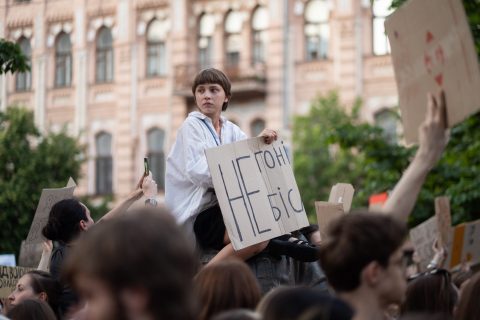
Ukraine was the only country among the seven assessed to receive the highest score for the extent to which the state considers civil society organizations (CSOs) full partners. “This may be linked to the EU accession process: think tanks and expert organizations analyze the acquis, prepare shadow reports, and contribute to aligning legislation with EU rules. Ukraine is also the only country in the group where there have been no institutional attempts to introduce the ‘foreign agents’ narrative,” says Oksana Kuziakiv, Executive Director of the Institute for Economic Research and Policy Consulting (IER) and a co-author of the report.
Weaknesses: transparency, consultations, and funding
Ukraine received its lowest scores for the transparency of public institutions and the timeliness of consultations with civil society, scoring 2 points in each area. Although the state recognizes civil society as a partner, martial law has made reduced transparency more commonplace. Consultations, including those within EU integration working groups, often take place too late, involve only selected stakeholders, or lack coordination. The “CSOs as Policy Actors” cluster scored 2.80, making it Ukraine’s weakest area. However, Ukraine ranks second only to Poland in this cluster, suggesting that the challenge affects the entire region.
The report identifies the financial sustainability of Ukraine’s civil society sector as a key vulnerability. Only about 8% of organizations receive funding from the state or local budgets. The suspension of U.S. assistance in 2025 negatively affected 22.3% of active Ukrainian CSOs, and 57% of those affected were unable to replace the lost funding.
Since 2022, the EU has provided more than €200 million to Ukrainian CSOs. However, replacing one external donor with another does not eliminate dependency. Ukraine has no mechanism allowing taxpayers to allocate a percentage of their tax payments to CSOs, while banks routinely treat civil society organizations as high-risk clients. Other challenges identified by the authors include mobilization, emigration, burnout, and the loss of experienced experts to government service. These trends are eroding the sector’s human capital.
“Ukraine is a country with exceptionally strong civic engagement. The main task now is to build the institutions and resources needed to turn this engagement into a lasting influence on public policy,” concludes Oksana Kuziakiv.
About 4liberty.eu
4liberty.eu is a platform where experts and intellectuals from Central and Eastern Europe who share liberal values exchange ideas and perspectives.
Representatives of 15 think tanks from countries including Poland, Hungary, Slovakia, Slovenia, the Czech Republic, Bulgaria, Ukraine, Estonia, Lithuania, and Germany regularly contribute commentary and analysis on political, economic, social, and cultural developments, as well as issues at the center of public debate, from a Central European perspective. The Institute for Economic Research and Policy Consulting is part of the 4liberty.eu platform.
Previous news item
Trade Facilitation Monitoring in Ukraine №106: new rules for parcels and simpler customs procedures
Next news item