The Institute for Economic Research and Policy Consulting (IER), with the support of the Center for International Private Enterprise (CIPE), has presented an analytical report on the state of Ukraine’s export logistics, “Strengthening the Resilience of Ukraine’s Export Logistics.”
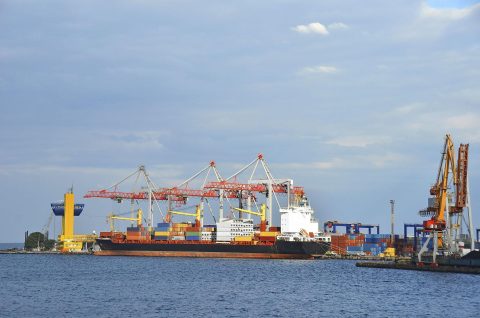
Odesa Port, 2016. Photo: George Chernilevsky, Wikimedia Commons
According to the analysis, the war has fundamentally reshaped the structure of Ukrainian exports by mode of transport. Maritime routes remain the backbone of the export system in terms of volume, accounting for nearly 70% of total tonnage, but their share of export value has fallen to 47–48%, compared with 62% before the full-scale invasion. By contrast, the share of road transport in the value of exports increased from 22.3% in 2021 to 39.8% in 2025, even though road transport accounts for less than 10% of the physical volume of goods. Rail transport, meanwhile, remains primarily used for lower-value bulk commodities such as grain, ores, and other raw materials.
“Up to July this year, logistics continuity remained relatively high, but highly concentrated. Most export flows were routed through just a few Polish road and rail border crossings and three deep-water ports, making the system vulnerable to disruptions at several critical nodes. Predictability was weakest in maritime and road transport, where ongoing attacks on port infrastructure, lengthy border queues, and Poland’s monitoring requirements under the Register of International Road Transport (RMPD) continued to undermine planning. Route diversification remained extremely limited,” says IER Lead Researcher Iryna Kosse.
According to her, each new shock to maritime transport simultaneously puts pressure on every western border crossing and redirects flows to the land-based network, which can replace only between one-quarter and one-third of maritime capacity. Flows are also redirected to the land border, where Poland alone accounts for around half of the total capacity for freight road transport. “As a result, nothing can fully replace Ukrainian ports in terms of cargo-handling capacity,” Iryna Kosse notes.
In addition to the physical constraints on Ukraine’s export logistics caused by Russian attacks, the sector also faces a number of institutional barriers.
These include:
the state monopoly over ports and railways, with insufficient incentives for investment in the sector;
the absence of a government policy for allocating freight across different modes of transport, as well as a single tariff regulator for intermodal transport involving two or more modes;
Poland’s RMPD system, which requires continuous geolocation tracking of transit vehicles and imposes fines of up to PLN 12,000 for disruptions in the tracking signal, as well as the EU’s new “90 days in 180” rule for non-resident drivers;
the lack of market-based safety mechanisms, such as blacklists for carriers and freight forwarders.
“The greatest improvements could be achieved through better management of cross-border traffic, including adequate staffing, transparent data on border-crossing capacity, and stronger oversight of all processes,” Iryna Kosse notes.
At the same time, reducing the vulnerability of maritime routes requires not only physical protection but also unlocking untapped potential through tariff incentives, appropriate market incentives, and transport policies that are currently lacking.
In the longer term, Ukraine’s export logistics could be improved by eliminating monopoly distortions, reforming the railway sector, establishing an intermodal tariff regulator, and strengthening the institutional framework for multimodal transport.
Prepared with the support of the Center for International Private Enterprise (CIPE). The views expressed in the report are those of the author and do not necessarily reflect the views of CIPE.
The project aims to assess the key risks and barriers affecting export logistics, identify priority areas for improving the logistics system, and develop practical recommendations for government authorities and market participants