


IER Project
Business SurveysIER Business Surveys monitor, forecast, and analyze economic activity in Ukraine using first-hand information collected directly from business leaders and company representatives

The Business Activity Recovery Index (BARI) continued to decline in October, falling from -0.21 to -0.24 – its lowest level in more than three years, since March 2023.
This is according to the 54th monthly survey, conducted by the Institute for Economic Research and Policy Consulting (IER) in October among 467 enterprises of all sizes.
The share of enterprises reporting lower business activity than a year earlier edged down from 31.1% to 29.2%. The share reporting an improvement also fell, from 9.6% to 5.4%. Meanwhile, the proportion reporting no change rose from 59.4% to 65.4%.
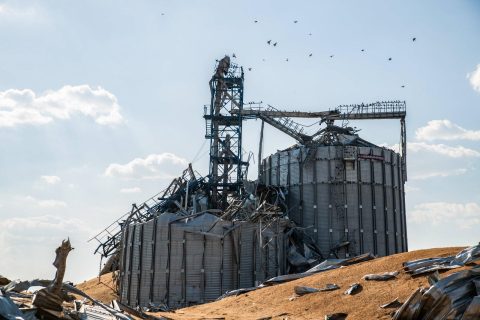
“These are alarming figures. They suggest that we have reached a ceiling and that the changes needed are no longer a matter of economic policy, but of security policy. The escalation began in mid-summer and continued through August and September. We are now seeing the consequences of intensified attacks on civilian infrastructure and on businesses unrelated to the defence industry,” noted Oksana Kuziakiv, Executive Director of IER.
The BARI improved among large enterprises, although it remained in negative territory. Meanwhile, the index showed little change among medium-sized, small and micro enterprises.
Capacity utilisation remained broadly unchanged compared with pre-war levels. The share of enterprises operating at full capacity rose from 5% to 6% in October, indicating that they had returned to their pre-war level of activity. By contrast, the share operating at near-full capacity continued to decline for the third consecutive month, falling from 47% to 44%.
The share of enterprises operating at 50–74% of capacity edged up to 32%, from 31% in September. Meanwhile, the proportion of enterprises that were not operating at all fell back to 3%, from 5% in September.
“We are seeing a gradual decline in capacity utilisation, mainly among businesses that had almost returned to pre-war levels,” says Oksana Kuziakiv.
The composite indicator of industrial outlook, which reflects the short-term outlook, declined from 0.04 to 0.03. Production expectations weakened, while stocks of finished goods and the volume of new orders increased.
Looking six months ahead, uncertainty decreased both regarding the overall economic environment (to 28.5%) and the financial and economic situation of enterprises (to 25.1%).
“Uncertainty about the long-term outlook unexpectedly eased, falling from 47.5% to 42.6%. The share of enterprises unable to assess their business outlook two years ahead decreased by almost five percentage points,” commented Oksana Kuziakiv.
Expectations for the next two years reached a new high: 87.9% of enterprises plan to maintain their current level of activity, while 8.1% intend to expand and 4% expect to scale down.
Production indicators showed mixed trends. The share of enterprises reporting an increase in production compared with September fell from 22.4% to 20.4%. At the same time, the share reporting a decrease also declined, from 22.6% to 15.5%. Looking ahead to the next three to four months, expectations deteriorated: fewer enterprises plan to increase production, while more expect to cut output.
Export trends followed a similar pattern. The share of enterprises reporting an increase in exports fell from 26.4% to 22.8%, while the share reporting a decrease edged down from 19.7% to 17.7%. Expectations for both export growth and decline also became less common.
Expectations for new orders and sales weakened, although actual sales and the volume of new orders increased.
“The average order backlog in October stood at 2.6 months, down from 2.7 months in September. The share of enterprises with orders covering at least one to two months increased from 37% to 41%. However, as many as 27% continue to operate from one order to the next, with little or no order backlog. Only 2% of enterprises now have orders extending a year ahead. The lack of long-term orders is a worrying sign,” Oksana Kuziakiv pointed out.
Enterprises in metal production and metalworking reported the longest order backlogs, at 3.5 months, followed by the wood-processing industry at 3.4 months. The chemical industry (3 months) and food industry (2.5 months) also had relatively long order backlogs. Printing had the shortest, at just 1.5 months.
“Price increases remain fairly steep, although they have been less rapid than businesses expected. At the same time, enterprises continue to anticipate a similar pace of growth in the cost of raw materials and supplies,” Oksana Kuziakiv explained. Over the next three months, 58.6% of enterprises expect the cost of raw materials and supplies to rise, while 58.5% anticipate higher prices for finished goods.
The IER’s New Monthly Enterprises Survey (NRES) covers up to 500 Ukrainian industrial enterprises operating in 21 of Ukraine’s 27 regions. The survey has been conducted every month since May 2022.
Watch the video presentation of the October survey results here.
The full survey report is available for download below.
IER Business Surveys monitor, forecast, and analyze economic activity in Ukraine using first-hand information collected directly from business leaders and company representatives